
The South of Colombia: Andes Massif, Amazonian Foothills, and the Amazon forest.
We traveled for a second time with Suz and Dan from Idaho, this time we visited the south of Colombia. Once in the south, the Andes form a single mountain range—the three characteristic branches of the Colombian Andes are still part of one massif, known as the Colombian massif. From here you can easily reach the tops of the mountains, but also the Amazon by passing through the foothills, creating a unique mix for a single trip, loaded with birds and with a high chance of encountering other wildlife.
During the 10-day trip, we recorded 270 bird species, incredible monkeys, and beautiful moments!

As soon as we landed in Pitalito, we made a short visit to Marengo, a small private reserve loaded with beautiful flowers where we spotted the Red-billed Emerald and the Shining Green Hummingbird, among other species.

Our first full day in the field took place at Drymophila Reserve, a 50-hectare primary forest in the buffer area of Los Guacharos (Oilbirds) National Park. Birds were everywhere, and we quickly started to spot several of the main targets: Red-bellied Grackles, Scarlet-rumped Cacique, Western Fire-eye, the skulky Long-tailed Tapaculo, and the endemic Tolima Blossomcrown, Violet-fronted Brilliant, among others.

After a breakfast with a view, we moved into the Hooded Antpitta area; males and females showed off and gave us a beautiful display, followed by glimpses—twice!—of the Schwartz’s Antthrush. The same happened with a Black-chested Fruiteater male in the canopy. During lunch we stayed around the hummingbird feeders and spotted over 12 species, adding two main targets: Short-tailed Emerald and Gorgeted Woodstar. The endemic Dusky-headed Brush-Finch also visited the surrounding bushes. Before departing to return to our lodge, we spotted the uncommon Rufous-tailed Tyrant, and our last addition was the beautiful East‑Andean Antbird.
During the night, a pair of Tropical Screech-Owls ended this first full day.

El Encanto Nature Reserve area
a month ago a beautiful write about El Encanto was published in the American birding association magazine, we took a couple of copies for the family, you can access by clicking on the next link:

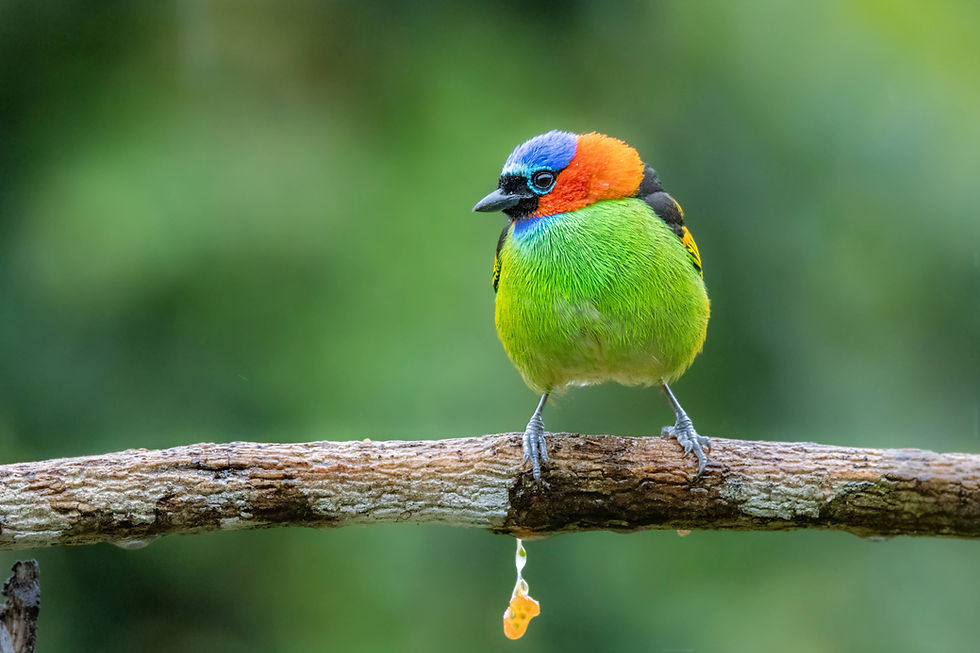
Starting the morning with a great organic coffee from the reserve itself and watching incredible birds in the backyard, the colorful tanagers visiting the feeders—Bay-headed Tanager, Crimson-backed Tanager, Green Honeycreeper, and Blue-necked Tanager—plus a couple of Red-headed Barbet. We did a walk in the shaded ground-coffee area; these areas are known for being excellent for migratory birds. We spotted the Cerulean Warbler, Canada Warbler, Blackburnian Warbler, and also Summer Tanager. A pair of White-winged Becards, Ash-browed Spinetail, and a glimpse of White-crowned Tapaculo. Back at the lodge backyard, we finally watched the Golden-eared Tanager and the endemic Tolima Dove.

In the afternoon we went to the rural neighborhood, which is loaded with shade-grown coffee, and we added to our list: Bronze-winged Parrot, White-lined Tanager, and a nice-looking male Cerulean Warbler, Buff-necked Ibis, and hummingbirds such as Red-bellied Emerald and Short-tailed Emerald, among others. Now it’s time to head into the Amazon foothills!

During our transfer to the Amazon foothills we made a short stop along the way—the car battery decided to die, and that short stop turned into 2 hours of birding. A male Crested Quetzal flew by the road and we quickly spotted it perched in the distance; the spotting-scope views were amazing. After hard work we got perfect views of the very uncommon Barred Antthrush, and the Uniform Antshrike was also spotted.

Our midday stop was Discosura Reserve, a new private reserve and conservation project located in the Amazonian foothills. That day they were celebrating a local birding festival, with lots of people from the community, and we gave a short speech, followed by a delicious pork dish from the local cuisine!

After lunch we enjoyed the local birds: Wire-crested Thorntail, Golden-tailed Sapphire, Glittering-throated Emerald, Ecuadorian Tyrannulet, Masked Tanager, and Rusty-winged Antwren, among others.

Late afternoon brought an incredible encounter with an amazing South American Bushmaster. A local from the community found it very close to a farmhouse and safely relocated it toward the nearby forest, a commendable effort to keep both people and wildlife safe. The Bushmaster, one of the longest venomous snakes in the Neotropics, is primarily nocturnal, which can make sightings rare. We stood in respectful silence, keeping a generous distance!

The Trampoline Road
An incredible zigzagging road that connects the Amazon Basin with the top of the Andes in southern Colombia, all flanked by primary forest rich in southern Colombia specialties and range-restricted species also shared with northern Ecuador.

The morning started beautifully with a pair of White-rimmed Brush-Finch, followed by the amazing Deep-blue Flowerpiercer. After delicious corn bread filled with cheese at the top of the mountain, we began to walk downhill. After we heard the unique call of the Slate-crowned Antpitta, we had a memorable moment waiting and watching this bird, and also the Rufous-headed Pygmy Tyrant jumping and snapping its wings in the forest.


A small flock of birds was good for seeing Yellow-throated Tanager, Flame-faced Tanager, Bluish and Deep-blue Flowerpiercer.

During our stop for lunch in the field we spotted a beautiful female Andean Cock-of-the-Rock, and we also got incredible views of two range-restricted birds to the south: the Black-streaked Puffbird and the Coppery-chested Jacamar.

On our second day in the Amazonian foothills, we focused on remaining targets. This time we waited to catch a mixed flock: Yellow-throated Chlorospingus and Yellow-throated Chlorospingus, with a few Yellow-throated Tanager, as well as the beautiful Green-backed Hillstar and Green-fronted Lancebill. Later in the morning we got our main target, the Orange-eared Tanager.

In the afternoon we decided to visit a lower-elevation area, where the first bird we spotted was the amazing male Plum-throated Cotinga, followed by a Gilded Barbet and a Thrush-like Wren. A mixed flock of different birds chased a Ferruginous Pygmy Owl: Yellow-bellied Dacnis, Turquoise, Masked Tanager, Silver-beaked Tanager, among others.

El Escondite
Our first Amazonian spot was El Escondite Reserve. This is a 50-hectare ex-cattle ranch turned into a conservation project about two decades ago—the secondary old-growth forest and patches of primary forest are home to several Amazonian species. We started our morning with the Swallow-winged Puffbird and Opal-rumped Tanager perched in the canopy, a family of Saddle-backed Tamarins, and also squirrel monkeys were part of the morning.

We caught a glimpse of the elusive Black-banded Crake inside the forest and the Coraya Wren, plus a pair of White-shouldered Antbird and the Rusty-fronted Tody Flycatcher. In the open areas we spotted several birds, including the Orange-fronted Plushcap and a pair of Lafresnaye’s Piculet. During the afternoon we added a couple of species to our list: Dark-breasted Spinetail.

First day in the Amazon forest near Puerto Asís
We visited Playa Rica, a community-based program that includes birdwatching as an excuse for conservation, very well organized with local indigenous guides, electric-solar panels, boat rides along the river, and delicious local food. During the boat ride we spotted some good birds, but once we started to walk along the path inside the community we spotted: Black-banded Woodcreeper, Plain-brown Woodcreeper, and a very exposed male Great Antshrike—a remarkable sight by antshrike standards. A male Amazonian Umbrellabird flew right above us! Chestnut-eared and Lettered Aracari were also getting some fruit from Cecropia trees, and the beautiful White-eared Jacamar was literally everywhere. The beautiful song of the Thrush-like Wren joined us for the morning.


A family of Saddle-backed Tamarins was moving around.
Late in the morning we spotted a Ferruginous Pygmy Owl; the Red-eyed and Yellow-green Vireos were crazy—jumping and chasing the owl—as well as Glittering-throated Emerald, Black-throated Mango, and various flycatchers.

During lunch we spotted the colorful Masked Crimson Tanager, Red-capped Cardinal, and the beautiful Orange-backed Troupial, as well as the Riparian Parrotlet and Dusky-headed Parrot. Last but not least, 3–4 Ornate Titi Monkeys moved through the forest canopy.
During our last morning we visited Amazon’s Bird, a private conservation project that protects one of the last pieces of forest in good shape in the area; it is home to several birds as well as at least eight species of monkeys.

We started with one of the most amazing monkeys, the Pygmy Marmoset. This little guy is not only hard to find but also incredibly small and fast enough to disappear! During the walk we added some cool birds: Peruvian Warbling Antbird, Silvered Antbird, the colorful Striolated Manakin, Chestnut Woodpecker, White-fronted Nunbird, Amazonian Barred Woodcreeper, and Purple-throated Fruitcrow, among others.



Great descriptions, Alejo, of beauty birds and settings. Sounds like a marvelous trip! You sure do this well!
This is the most wonderfull trips that you can get, great persons and great adventures, Good pictures Bro, congrats