
Searching for the Spectacled Bear: Guardian of the Páramo
- Apr 19
- 3 min read
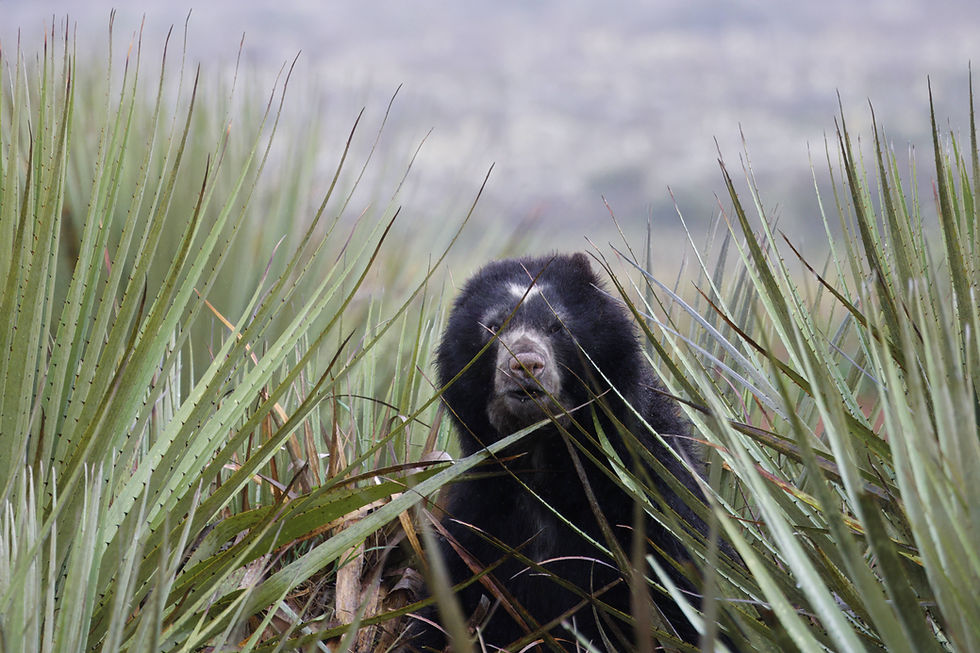
High in the northern Andes, where the air thins and the landscape transforms into a mosaic of mist, frailejones (espelettia sp), and silent valleys, lives one of South America’s most elusive mammals: the Spectacled Bear. Known locally as the “Oso de Anteojos” or "Oso Andino" this species is more than just a rare sight—it is a symbol of the Andean wilderness and a quiet guardian of its most fragile ecosystems, forest and Paramos.

A Bear of the Clouds
The spectacled bear is the only bear species native to South America and the last surviving member of the short-faced bear lineage. It inhabits a vast but fragmented range along the Andes, from Venezuela to Bolivia, with Colombia representing one of its most important strongholds.

In Colombia, populations are distributed across the three Andean cordilleras, moving between cloud forests, high Andean forests, and páramo ecosystems. These bears are not strictly bound to one habitat; instead, they are seasonal travelers, following food availability across elevations that can range from about 500 to over 3,500 meters.

Despite this wide distribution, their populations are fragmented. Habitat loss, agricultural expansion, and human-wildlife conflict have divided what was once a continuous range into isolated pockets.

Population and Conservation Status
Globally, the spectacled bear is classified as Vulnerable by conservation authorities. In Colombia, although exact population numbers are difficult to determine due to their elusive nature, it is considered one of the most important countries for its conservation. Genetic studies suggest that Colombian populations still retain relatively high genetic diversity, but increasing fragmentation threatens long-term connectivity.

The main threats include:
Habitat destruction due to agriculture and mining
Retaliatory killing linked to livestock predation
Climate change, which is pushing Andean ecosystems—and the bear’s habitat—upslope
Other threats includes the new paved roads that crosses the forest and Paramos and the division of private land by using barbed wire that can affect free movement of the bears and other wildlife.


Because of this, the spectacled bear is often considered an umbrella species: protecting it means protecting entire ecosystems like páramos and cloud forests.
Life, Behavior, and Reproduction
Unlike many other bears, the spectacled bear is largely herbivorous. Its diet consists mainly of fruits, bromeliads, palm hearts, and other plant material, with only a small percentage of animal matter.

It is also an excellent climber, often building feeding platforms in trees and spending significant time above ground.

Reproduction in this species remains partially mysterious. Mating can occur between April and June, although some flexibility exists depending on food availability. Females typically give birth to one or two cubs after a gestation period that may include delayed implantation—a strategy that allows births to coincide with favorable environmental conditions.

Cubs stay with their mother for an extended period - up to two years - learning survival skills in a landscape where resources are scattered and conditions can be harsh.

The Bear and the Páramo
To understand the spectacled bear, one must understand the páramo.This high-altitude ecosystem, unique to the northern Andes, is a world of extremes—intense sunlight, freezing nights, and constant humidity. Yet it is also one of the most important water sources in the region, capturing and regulating water for millions of people.

The spectacled bear plays a crucial ecological role here:
It disperses seeds across large distances
It shapes vegetation by feeding and breaking branches
It even creates canopy gaps that allow new plants to grow
In cloud forests and high Andean forests, its movements connect ecosystems, making it a key driver of ecological processes.

A Ghost of the Andes
Despite its size, the spectacled bear is rarely seen. It moves quietly through dense vegetation, leaving behind only subtle signs: claw marks on trees, broken branches, and footprints fading into mud.

For many, searching for this bear becomes something deeper than wildlife observation. It is a lesson of patience, silence, and respect for landscapes.

To encounter the spectacled bear, even briefly, is to witness not just a species, but a living thread in the fabric of the páramo—a guardian whose survival is inseparable from the fate of the mountains themselves.


Comments